Industries / Figureheads
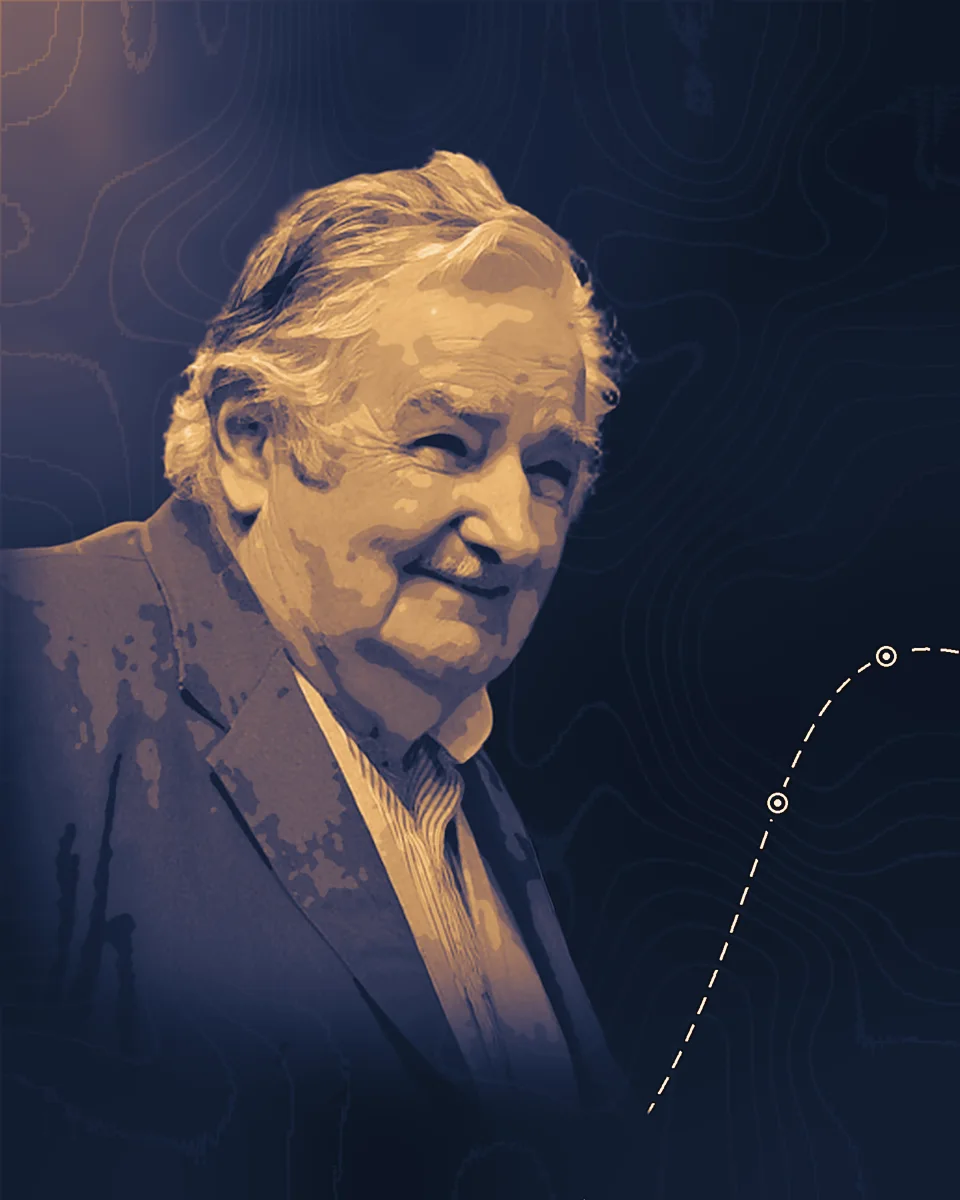
José Mujica
As president of Uruguay he proposed and signed the law that made it the first country to license and regulate cannabis at every stage from seed to sale.
1935–2025
What they changed
2012
A state-run market proposed
In June 2012 Mujica's government put forward a 15-point plan on crime and public safety, the "Strategy for Life and Coexistence", that included legalizing and controlling cannabis sales and state production. CIDOB, the Barcelona institute that keeps biographies of world leaders, notes that the measure had not been in his election programme and that he justified it as a way to cut the violence of the drug trade.
2013
Law 19.172
The Chamber of Representatives passed the bill on 31 July 2013 and the Senate on 10 December 2013, both by narrow majorities, and the law was promulgated on 20 December 2013. It puts the import, production, acquisition, storage, sale and distribution of cannabis under state control and regulation, and created a regulator, the Institute for the Regulation and Control of Cannabis (IRCCA).
2014
Three ways to obtain it
Regulations issued in May 2014 set three routes for adult citizens and residents, each needing registration and each exclusive of the others: buying up to 40 grams a month from pharmacies supplied by licensed growers, growing up to six plants at home, or joining a club of 15 to 45 members growing up to 99 plants. The register of home growers opened in August 2014 and club registration in October 2014.
2017
Sales begin in pharmacies
Pharmacy sales began on 19 July 2017, after Mujica had left office. By 31 December 2025, IRCCA counted 113,548 people registered to obtain cannabis legally, 557 licensed clubs, and 19.4 tonnes sold in 5-gram packs in 3.88 million pharmacy sales.
Life
José Mujica Cordano was born in Montevideo on 20 May 1935 and grew up on a small family farm on the city's edge. Reuters notes that he claimed to have been born a year earlier than his birth certificate says. He left secondary school before finishing, entered politics in a progressive wing of the National Party and, in the mid-1960s, joined the Tupamaros, the National Liberation Movement, an urban guerrilla group.
The Tupamaros took up arms against a government that was then constitutional and democratic. CIDOB records kidnappings, bombings, bank robberies and the killing of police officers they accused of torture, and says many of these actions were planned and carried out with Mujica's part as a member of the leadership; in a 1999 book of interviews he said he regretted none of them. Reuters reports that he said he never killed anyone. He was shot six times in clashes with the security forces, escaped from Punta Carretas prison twice, and was captured for the last time in 1972. He spent about 13 years in prison, much of it in solitary confinement under the military dictatorship, until an amnesty freed him on 8 March 1985.
After his release he worked inside the left-wing coalition, the Broad Front, as a leader of the Movement of Popular Participation, served in parliament and was minister of agriculture under President Tabaré Vázquez. He was president from 2010 to 2015. Besides the cannabis law he signed laws allowing abortion early in pregnancy and same-sex marriage; CIDOB also records rising deficits and inflation and a failure to improve education, which he admitted.
The cannabis law was not his alone. John Walsh and Geoff Ramsey of the Washington Office on Latin America write that the groundwork was already laid: possession for personal use had been decriminalized since 1974, and a cross-party group of legislators, Sebastián Sabini and Julio Bango of the Broad Front, Fernando Amado of the Colorado Party and Daniel Radío of the Independent Party, had been working toward legal home growing before his government's proposal. His first bill had a single article, and after a poll showed 66% of Uruguayans against it he put the measure on hold for debate while Sabini and Bango rewrote their bill to fit his plan. Between 61% and 66% of Uruguayans opposed the law in polls from late 2012 to mid-2014, and the president of the International Narcotics Control Board accused Uruguay of a "pirate attitude". Mujica said Uruguay would not become a "paradise" for cannabis users and called the law an "experiment" against drug trafficking.
He lived through his presidency on his small farm outside Montevideo and gave most of his salary away, which earned him the name "the poorest president in the world". He later served in the Senate until he retired in October 2020. His wife, Lucía Topolansky, a fellow Tupamaro, was a senator and vice-president from 2017 to 2020. He was diagnosed with cancer of the oesophagus in 2024 and died on 13 May 2025, days before his 90th birthday.
Read more
5 accounts
José Mujica Cordano, Roberto Ortiz de Zárate, CIDOB, 2025.
A long biography in Spanish, from the Tupamaros to his death, with a section on the cannabis law.
cidob.org
Uruguay's Drug Policy: Major Innovations, Major Challenges, John Walsh and Geoff Ramsey, Brookings Institution, 2016.
How the law came about, what it says and how it compares with Colorado and Washington.
brookings.edu
Ley N° 19172, Marihuana y sus derivados, Uruguay, 2013.
The text of the law, in Uruguay's official legal database.
impo.com.uy
Mercado regulado del cannabis al 31 de diciembre de 2025, IRCCA, 2026.
The regulator's own count of registered buyers, growers, clubs and sales.
ircca.gub.uy
Jose Mujica, Uruguay's former leader, rebel icon and cannabis reformer, dead at 89, Reuters, 2025.
A news-agency obituary, republished by TimesLIVE.
timeslive.co.za