Industries / Figureheads
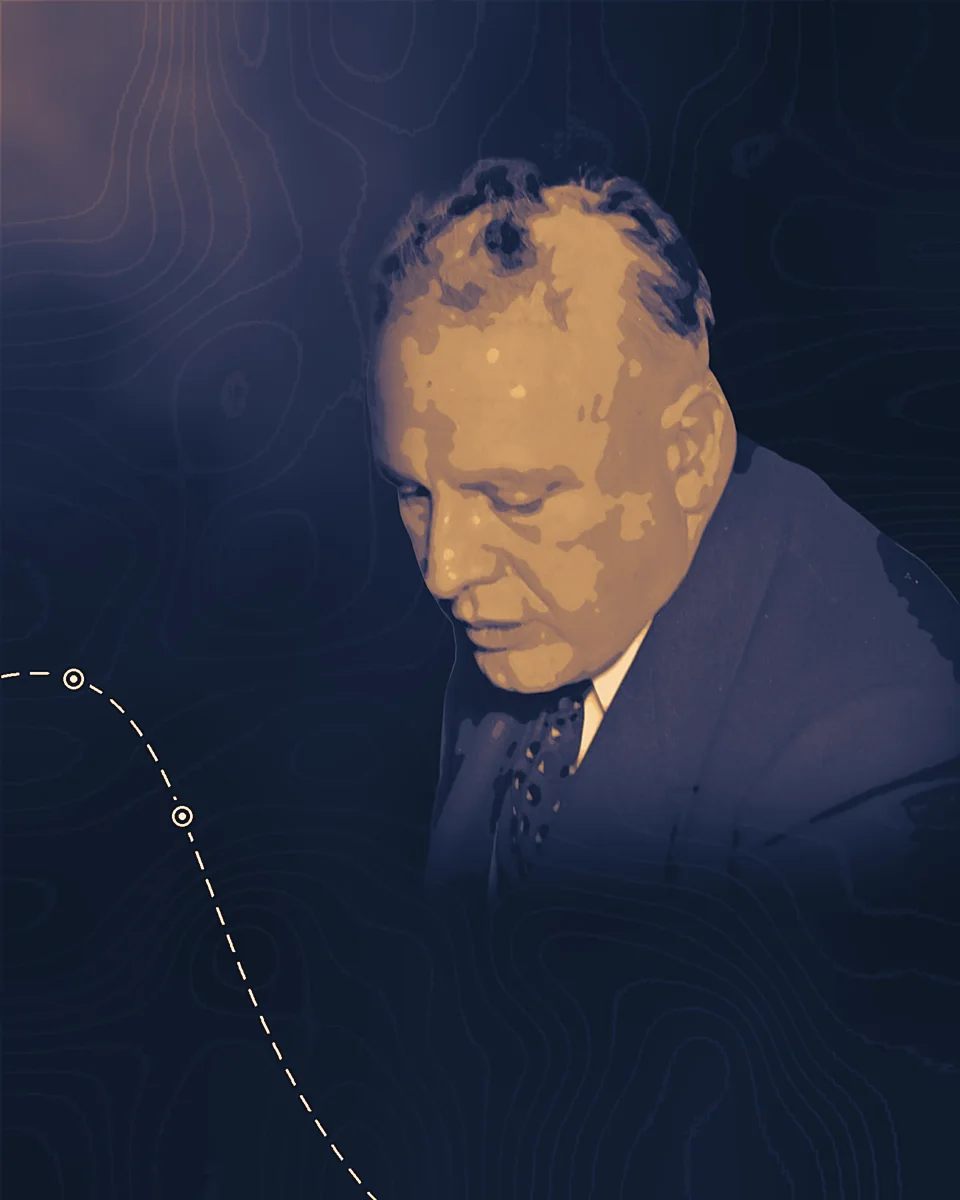
Harry J. Anslinger
As the first US Commissioner of Narcotics he carried the 1937 federal marihuana law through Congress and pressed for the UN treaty that still puts cannabis under international control, the prohibition the legal industry is carved out of.
1892–1975
What they changed
1930
A federal narcotics bureau
Anslinger became Commissioner of the new Federal Bureau of Narcotics in the US Treasury in 1930 and held the post until 1962. The UN Office on Drugs and Crime calls him a "key player in domestic and international drug control" from the early 1930s.
1937
The Marihuana Tax Act
The Treasury's bill put a tax on dealers in marihuana and on every transfer of it, with registration and records to back the tax. Anslinger testified for it: on 12 July 1937 he told a Senate Finance subcommittee of 338 seizures in 31 states the year before, and said that "in some cases one cigarette might develop a homicidal mania". The Congressional Research Service records that the Act made hemp farmers hold a federal registration and a special tax stamp, while still allowing industrial uses of the crop.
1948
A single drug treaty
As head of the US delegation, Anslinger launched the plan in 1948 to fold the older drug treaties into one Single Convention, by UNODC's history. The Single Convention on Narcotic Drugs was signed in New York on 30 March 1961. It lists cannabis and cannabis resin among controlled drugs, and its Article 28 exempts cannabis grown only for fibre, seed or horticulture. The UN Commission on Narcotic Drugs voted 27 to 25 in December 2020 to take cannabis out of Schedule IV, a list of drugs under extra restrictions; it stays in Schedule I.
1970
The 1937 definition lives on
The Controlled Substances Act of 1970, passed after Anslinger retired, adopted the 1937 Act's definition of Cannabis sativa and put marihuana in Schedule I, the class for drugs with no accepted medical use. Hemp was taken out of that definition only in December 2018.
Life
Harry Jacob Anslinger was born in Altoona, Pennsylvania, on 20 May 1892. He studied at Pennsylvania State College from 1913 to 1915. From 1918 he served the State Department abroad: at the US Legation in The Hague, as vice-consul in Hamburg, and as consul in La Guaira, Venezuela, and in Nassau, the Bahamas. He then ran the Treasury's Division of Foreign Control from 1926, became Assistant Commissioner of Prohibition in 1929 and took a law degree from the Washington College of Law in 1930.
The psychiatrist and historian David Musto, who read the bureau's files and interviewed Anslinger in 1970, wrote that fear of marihuana in the 1920s and 1930s was strongest where Mexican immigrants had settled, from Louisiana to California and Colorado, and that crimes there were blamed on the drug and "its Mexican purveyors". In Musto's account the bureau at first wanted the states to act, and as late as January 1937 Anslinger called marihuana an "intrastate problem". Pressure from police and governors in the Southwest reached the Treasury Secretary, and the Treasury's General Counsel, Herman Oliphant, devised the transfer tax, an idea Anslinger at first thought "ridiculous". Musto concluded that the bureau did not create the scare "nor can the law be simply ascribed to the Commissioner's determined will".
Musto also showed how the case was built. At a Treasury conference in January 1937 a department lawyer asked Anslinger, "Have you lots of cases on this-horror stories-that's what we want", and he had a collection. The Treasury left out more cautious medical opinion, including that of the Public Health Service's Walter Treadway, and the only witness against the bill, William Woodward of the American Medical Association, was met with hostile questions when he said the evidence was incomplete. Musto called the hearings "a classic example of bureaucratic overkill". Anslinger told the senators that hemp growers were "amply protected" by the bill.
After the Act, Musto records, the bureau attacked medical findings that played down the drug's dangers, among them New York's La Guardia Report of 1944, while also shutting down private scare campaigns it thought would alarm the public. Anslinger represented the United States at the UN Commission on Narcotic Drugs. He left the bureau in 1962 and died in Hollidaysburg, Pennsylvania, on 14 November 1975.
How much the Act was Anslinger's own work is still argued. A Georgetown University project that supplements a study titled "Harry Anslinger Saves the World: National Security Imperatives and the 1937 Marihuana Tax Act" argues that the standard histories, Musto's among them, rest on thin evidence, that secret national-security concerns shaped the law, and that Musto's interviews with Anslinger left no transcript for others to check.
Read more
5 accounts
The Marihuana Tax Act of 1937, David F.
Musto, Archives of General Psychiatry, 1972. The standard history of the Act, from the bureau's files and interviews with Anslinger.
doi.org
Taxation of Marihuana, hearing before a subcommittee of the Committee on Finance, United States Senate, 1937.
The printed hearing on H.R. 6906, with Anslinger's testimony in full.
finance.senate.gov
A Century of International Drug Control, UN Office on Drugs and Crime, 2008.
The UN's history of the drug treaties from 1909, extended from a chapter of its World Drug Report 2008.
unodc.org
Harry J. Anslinger Papers, Harry S. Truman Library, undated. The finding aid, with a chronology of his career and a description of his papers.
trumanlibrary.gov
1937 Marihuana Tax Act, Georgetown University, undated. A historian's commentary on the Act's documents and on the older histories of it, Musto's among them.
sites.google.com