Industries / Figureheads
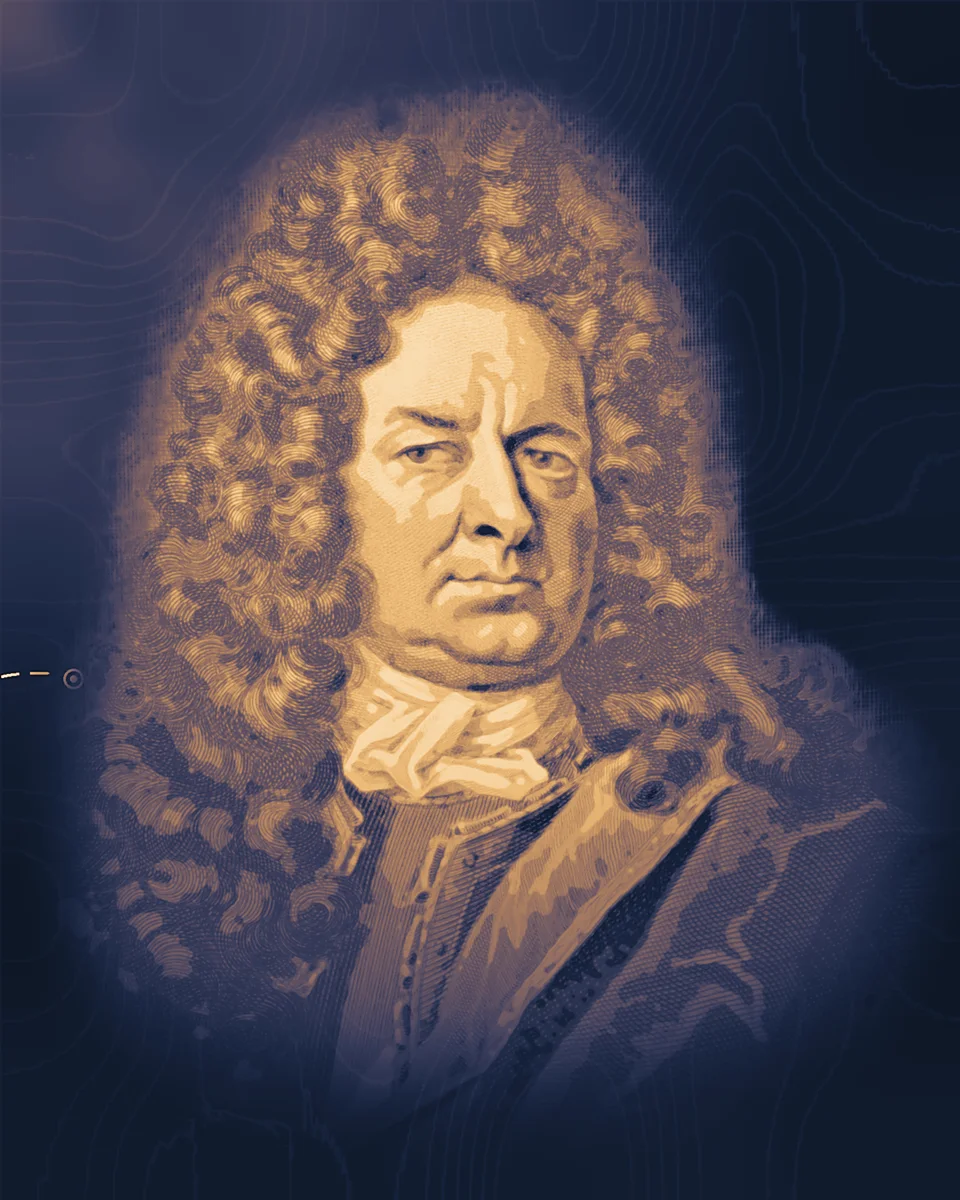
Hans Carl von Carlowitz
He wrote the first book on forestry alone, and argued that wood must be planted and regrown as fast as it is cut.
1645–1714
What they changed
1713
A book on forestry alone
Carlowitz published Sylvicultura oeconomica in Leipzig in 1713. Until then forestry had been a side subject in books on farming and hunting. The Neue Deutsche Biographie, Germany's national biography, calls it the first purely forestry work in the world. The Sächsische Biografie, the Saxon biography, claims less: the first book in German given to forestry alone.
1713
Sustained use
On page 105 he asked how wood could be conserved and grown so that it gave "eine continuirliche beständige und nachhaltende Nutzung", a continual, steady and sustained use. The historian Ulrich Grober reads this as the first use of the German word for "sustained" in its modern sense. Cutting no more than can be regrown became a guiding rule of forestry.
1713
Sow, plant and save
The book set out how to sow and plant forest trees and how to lay out tree nurseries. It also told readers to burn less wood: better stoves and smelting furnaces, houses that hold their heat, and peat in place of timber. Its plainest message, in the UN Food and Agriculture Organization's account, was that there would be no wood in future unless cut ground was replanted.
1732
A second edition
Julius Bernhard von Rohr brought out an enlarged edition 18 years after Carlowitz died. The book was required reading for German foresters, economists and mining officials for decades. In 1795 Georg Ludwig Hartig turned its idea into a working rule: assess a forest's yield, and cut so that later generations get at least as much from it as the living one.
Life
Hans Carl von Carlowitz was born in 1645 at Rabenstein, near Chemnitz in Saxony, the second of 17 children. His father, Georg Carl von Carlowitz, oversaw the rafting of timber out of the Erzgebirge, the Ore Mountains, and served the elector of Saxony as a district governor and master of the hunt. The son went to school in Halle from 1659 and to the University of Jena in 1664.
From 1665 to 1669 he travelled, as young nobles then did: through the German states to the Netherlands, where he studied briefly at Leiden and Utrecht, then England, Denmark, Sweden, France, Italy and Malta. He was in London for the Great Fire of September 1666. He was arrested there on suspicion of being one of the fire-raisers and freed after Prince Rupert stepped in. In France he met the forest reforms of Louis XIV's minister Jean-Baptiste Colbert, which led to the forest ordinance of 1669.
Back in Saxony he entered the elector's service. He first dealt with forests while helping his father run four districts in the Ore Mountains. In 1679 he was made deputy head of the Saxon mining administration at Freiberg, a silver town. He became a councillor for finance and mining in December 1709 and head of the administration at the end of 1711. The post made him answerable for the wood and charcoal that the mines and smelters burned. The mines employed about 10,000 miners, by the FAO's account, and the forests near them had been cut for generations with nothing done to regrow them.
He was a mining official, not a forester, and he wrote his one book at the end of his life. Its purpose was to keep the mines supplied with wood, not to protect forests for their own sake. He blamed the shortage on people who cleared woodland for quick profit and planted nothing because they would not live to cut it.
The idea was not his alone, and he said so. He quoted Colbert's ordinance at length and wrote that it already held the whole sum of his own project. A French law of 1346 had told forest owners to sell wood in a way that let the forests "perpetually sustain themselves", and John Evelyn's Sylva had urged the English to plant trees in 1664. The Sächsische Biografie says Carlowitz was not the "father of sustainability" he is often called today, but that he set the principle out forcefully and pressed for it to be enforced. The methods that put it to work, such as surveying a forest and fixing a yearly cut, came from later foresters.
He married Ursula Margaretha von Bose in 1675. He died in Freiberg on 3 March 1714, a year after the book came out. The family vault where he was buried was cleared in 1891 and his grave is lost.
Read more
4 accounts
Three hundred years of applied sustainability in forestry, Franz Schmithüsen, Unasylva 240, FAO, 2013.
A forest-policy professor's account of the book, what came before it and how the idea travelled to India and the United States.
fao.org
Deep roots: a conceptual history of "sustainable development" (Nachhaltigkeit), Ulrich Grober, Wissenschaftszentrum Berlin, 2007.
Sets Carlowitz beside Evelyn and Colbert, with page references to the 1713 text.
bibliothek.wzb.eu
Hans Carl von Carlowitz, Bernd Bendix, Sächsische Biografie, 2017.
The fullest short life, in German, drawn from the parish registers and the Saxon state archive.
saebi.isgv.de
Carlowitz, Hans Carl von, Albert Richter, Neue Deutsche Biographie 3, 1957.
The national biography's entry, in German, on the same page as Richard Hess's longer entry of 1876, which describes the book chapter by chapter.
deutsche-biographie.de