Industries / Figureheads
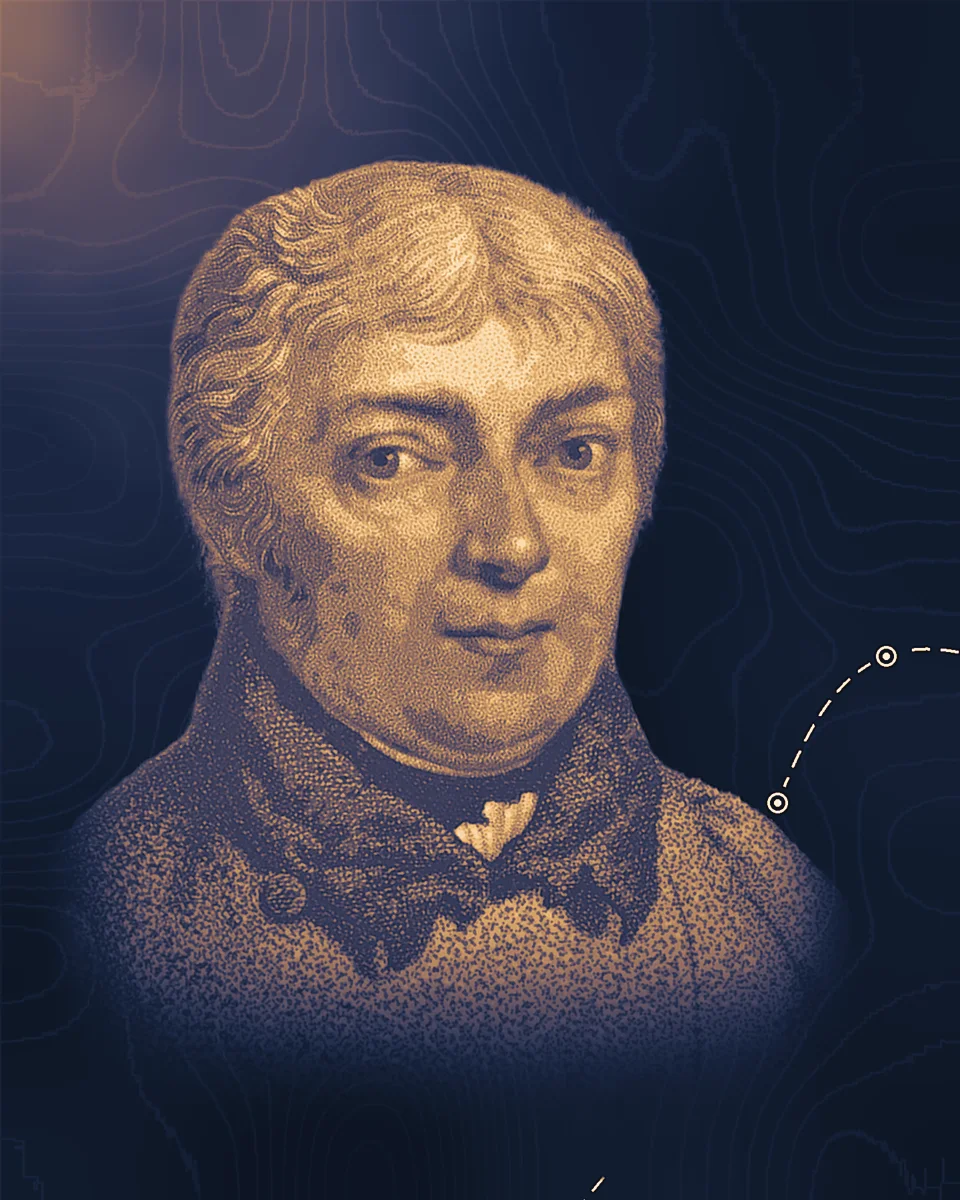
Georg Ludwig Hartig
He turned sustained yield from a principle into a working method: measure the forest, then spread the cutting evenly across the decades.
1764–1837
What they changed
1791
Rules for growing a forest
Hartig's Anweisung zur Holzzucht für Förster, instructions on growing wood for foresters, set out short general rules for raising beech forest from seed, for sowing, planting and thinning. The nineteenth-century German national biography says it gave silviculture, the craft of growing forest stands, its first scientific footing. It ran to eight editions by 1818.
1795
The cut planned ahead
In his book on assessing forests Hartig showed how to make a forest yield the same amount period after period. The forester measures the standing wood and its growth, divides the life of the forest into equal periods, and allots to each period an equal volume to cut. The method was later named volume allotment, in German Massenfachwerk. Prussia made it the basis of its forest assessments in 1819.
1795
A duty to later generations
The same book stated the aim in terms that are still quoted: a wise forest administration must use the woods "in a way that the descendants can draw at least as many advantages as the now-living generation appropriates".
1811
A state forest service
For 25 years from 1811 Hartig headed the forest administration of Prussia. The modern German national biography says his chief strength was organization: of the forest service, of forest management, of what foresters knew and of how they were taught. It credits him with keeping the Prussian state forests from being sold off, which followers of Adam Smith were urging.
1789–1837
Teaching foresters
From his first post Hartig took pupils. His school at Hungen moved with him to Dillenburg, where it had up to 50 students at a time, then to Stuttgart. In Berlin he lectured at the university. He taught for almost fifty years and wrote 31 works, some translated into other languages.
Life
Georg Ludwig Hartig was born on 2 September 1764 at Gladenbach, near Biedenkopf in what is now the German state of Hesse, into a family of foresters. He was apprenticed to an uncle at Harzburg, where he learned mostly hunting. His father thought that was not enough and sent him to the University of Giessen from 1781 to 1783, among the first foresters to study at a university. At 22 he became forest master at Hungen for the princes of Solms-Braunfels.
In 1797 he moved to Dillenburg to run the forests of the house of Nassau-Orange. When Napoleon took the territory and joined it to a new state, Hartig was offered the top forestry post there on good terms. He refused to swear loyalty and left without a post or savings, with nine children. He was soon called to Stuttgart as a senior forestry councillor in 1806, and to Berlin in 1811.
The idea he worked from was not his. Hans Carl von Carlowitz had written in 1713 that wood must be used in a continual and sustained way, and others had restated it since. Hartig and his contemporary Heinrich Cotta, who founded the forestry school at Tharandt in Saxony in 1811, are the two the German national biography calls the first of the "forestry classics", the men whose practice, research and teaching shaped the forestry of their time. It was Cotta who gave Hartig's allotment method its name.
His methods spread beyond Germany. Bernhard Lorentz, an Alsatian and a lifelong friend of Hartig, became the founder and first director of the French national forestry school at Nancy in 1824. Foresters trained at Nancy and in Germany later carried the same methods to British India and the United States.
His work had limits that were seen within a few decades. The 1879 national biography says his general rules had by then given way to treating each stand on its own terms, and that one of his cutting systems "was not a very happy one". In Berlin he quarrelled over principles with Wilhelm Pfeil, who was called there in 1821. His shelterwood method, which raises the new stand under the cover of the old trees, was used to establish large beech forests.
Hartig and his wife had thirteen children. Two sons died fighting the French. Another, Theodor Hartig, became a noted forest botanist. He died in Berlin on 2 February 1837, a few days after his wife.
Read more
3 accounts
Hartig, Georg Ludwig, Kurt Mantel, Neue Deutsche Biographie 7, 1966.
The modern national biography's assessment, in German. The same page carries Richard Hess's much longer life of 1879, with a list of all his writings.
deutsche-biographie.de
Three hundred years of applied sustainability in forestry, Franz Schmithüsen, Unasylva 240, FAO, 2013.
Quotes Hartig's 1795 statement in English and follows the idea from Carlowitz to India and America.
fao.org
Deep roots: a conceptual history of "sustainable development" (Nachhaltigkeit), Ulrich Grober, Wissenschaftszentrum Berlin, 2007.
Sets Hartig among the eighteenth-century writers who turned Carlowitz's word into a working concept.
bibliothek.wzb.eu