Industries / Figureheads
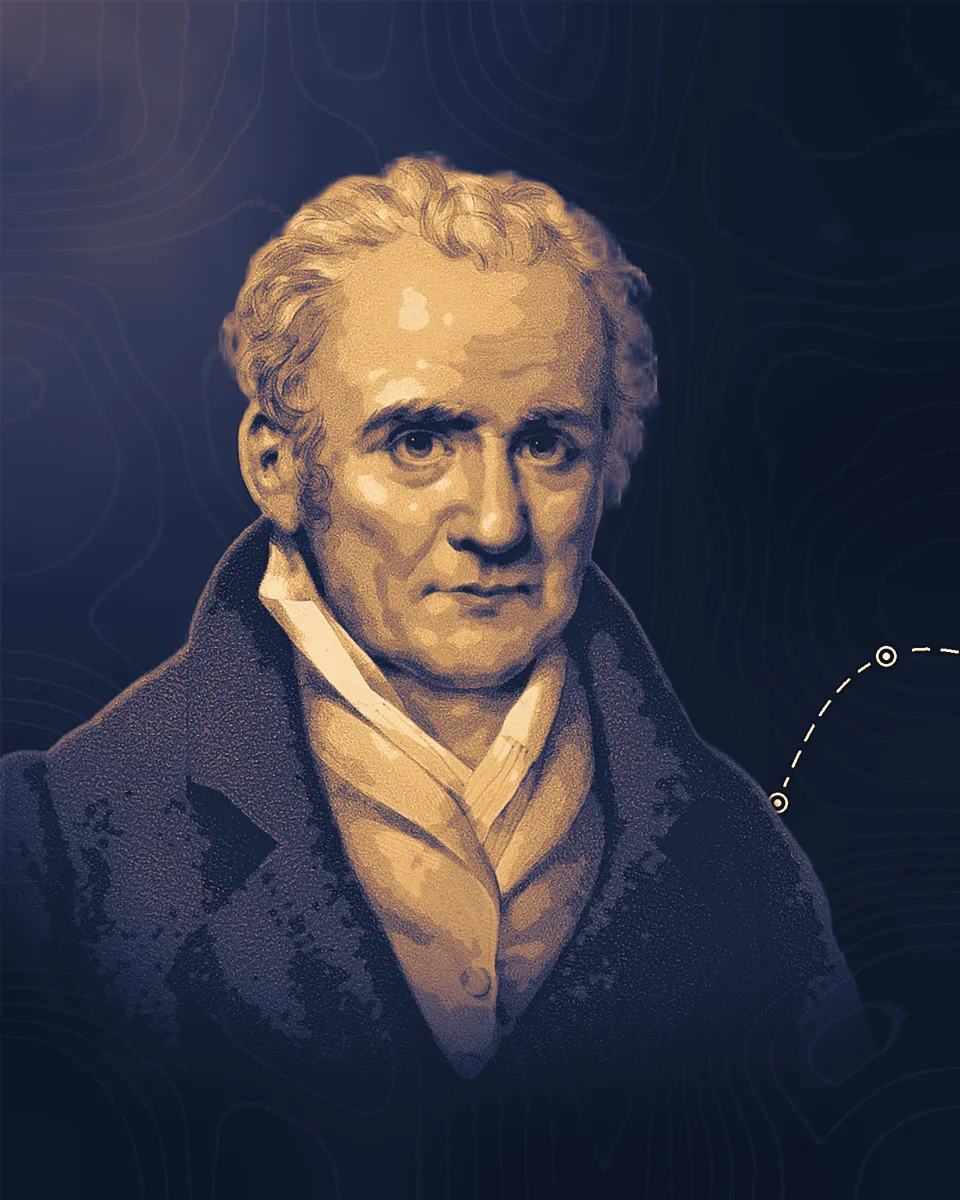
Gaspard Monge
He worked out descriptive geometry, the exact way of drawing a solid object as a plan and an elevation, and made it the core of how French engineers were trained.
1746–1818
What they changed
1760s
Geometry in place of arithmetic
At the Royal Engineering School at Mézières, which trained France's military engineers, Monge was set to work out a defilade: shaping a fortress's walls so that the defenders inside stay out of the attackers' fire. The usual method was long calculation. His student Charles Dupin wrote in 1819 that Monge solved it with a general geometric construction instead, which the school's commandant at first refused to examine.
1795
A military secret made public
Dupin wrote that the military engineers forbade their officers to share the manuscripts that held their methods, so descriptive geometry "resta secrète" (stayed secret) until the new École normale in Paris. Monge taught it there in Year III of the Republic (1794–95), and his lectures were printed in Year VII (1798–99) as Géométrie descriptive.
1799
Two drawings for three dimensions
The method projects an object onto two planes at right angles, one flat and one upright, which give its plan and its elevation. The book's first page says its first aim is to show exactly, on drawings of two dimensions, objects that have three, and calls it a language needed by whoever conceives a project, by those who direct the work and by the workers who make its parts. MacTutor, the University of St Andrews's history of mathematics, says it is "now known as orthographic projection".
1794
A school built on drawing
On 11 March 1794 the National Convention named Monge to the body that set up the school soon called the École polytechnique, and on 9 November he became its instructor in descriptive geometry. The historian Sveinn Jóhannesson writes that he gave the subject first place in the school's teaching, and that from 1816 it was taught at West Point, the US Military Academy, the first school outside the Polytechnique to take it up.
mathshistory.st-andrews.ac.ukfiscalmilitary.history.ox.ac.uk
Life
Gaspard Monge was born on 9 May 1746 in Beaune, in Burgundy. His father was a travelling merchant and later a shopkeeper in the town. A plan of Beaune he drew as a young man caught the eye of an officer from the engineering school at Mézières, and in 1765 he joined the school as a draftsman. Officer rank there was kept for the nobility, so he started as an employee.
mathshistory.st-andrews.ac.uknapoleon.org225.polytechnique.fr
He rose to teach mathematics at Mézières, succeeding Charles Bossut in January 1769, and in 1780 he was elected to the Académie des Sciences. The method was not his alone. Jóhannesson credits Monge "and his predecessors" at Mézières, and Dupin says the school already taught stonecutting, and that Monge improved and simplified its methods with his geometry. The 1799 book was put together from his lectures by his colleague Jean Hachette.
mathshistory.st-andrews.ac.ukfiscalmilitary.history.ox.ac.ukarchive.org
He backed the Revolution. In 1792 he became Minister of the Navy and resigned on 10 April 1793, and he sat on the Académie's commission on weights and measures. With Guyton, Fourcroy and Lamblardie he set up the École polytechnique, which he later directed at Napoleon's request.
From May 1796 to October 1797 he was in Italy on a commission to choose the works of art to be taken to France, among them the masterpieces the Pope had to give up. MacTutor describes it as selecting "the best art treasures for the conquerors". In 1798 he sailed with Napoleon's expedition to Egypt and led its scientific side with the chemist Claude Berthollet. Napoleon made him a senator and, in 1808, Count of Péluse.
He stayed loyal to Napoleon after Waterloo. The restored monarchy expelled him from the Institut de France and from the École polytechnique, and he died in Paris on 28 July 1818. MacTutor records that students of the school paid him tribute although the government had forbidden it.
Read more
5 accounts
Géométrie descriptive, Gaspard Monge, Paris, Year VII (1798–99).
His École normale lectures, with the programme that sets out what the method is for.
archive.org
Essai historique sur les services et les travaux scientifiques de Gaspard Monge, Charles Dupin, 1819.
A life written by his student the year after his death, with the story of the defilade and the secrecy at Mézières.
archive.org
Gaspard Monge, J. J. O'Connor and E. F. Robertson, MacTutor History of Mathematics, University of St Andrews. A long, referenced biography.
mathshistory.st-andrews.ac.uk
Seeing Like Soldiers in the United States, Sveinn M. Jóhannesson, University of Oxford fiscal-military history project, 2022.
How descriptive geometry reached West Point and what engineers' drawings were used for.
fiscalmilitary.history.ox.ac.uk
Monge, Gaspard, comte de Péluse, Marc Allégret, Revue du Souvenir Napoléonien, 2005.
A short dated life with his posts and titles, from the Fondation Napoléon.
napoleon.org