Industries / Figureheads
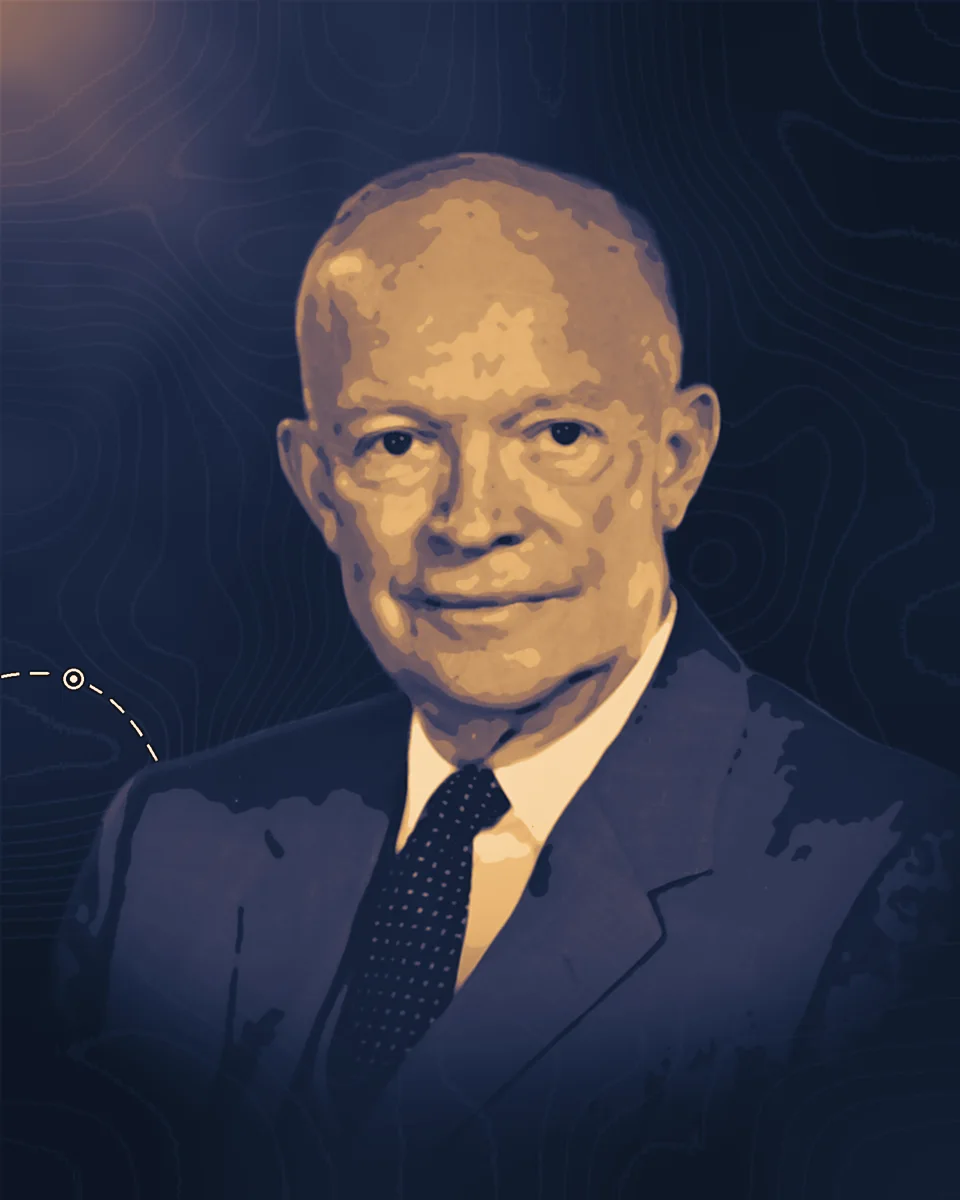
Dwight D. Eisenhower
After crossing the country with an Army truck convoy in 1919, he pushed through as president the 1956 law that built the US Interstate highways that long-haul trucks run on.
1890–1969
What they changed
1919
A convoy across the country
On 7 July 1919 an Army convoy of about 80 trucks and other vehicles left Washington, D.C., to test whether military motor vehicles could cross the continent, mostly on the Lincoln Highway. Eisenhower, a temporary lieutenant colonel of the Tank Corps, went along as an observer, and the convoy reached San Francisco on 5 September. Roads were mostly unpaved and bridges broke under the trucks. His report of 3 November 1919 said that "extended trips by trucks through the middle western part of the United States are impracticable until roads are improved".
1945
The autobahn lesson
As Supreme Commander in Europe he saw how Germany's four-lane autobahns moved troops and supplies. In his 1967 memoir he wrote: "The old convoy had started me thinking about good, two-lane highways, but Germany had made me see the wisdom of broader ribbons across the land."
1955
A highway plan for Congress
In September 1954 he appointed an advisory committee on a national highway program, headed by General Lucius D. Clay. On 22 February 1955 he sent Congress its plan with a message that gave more than 36,000 deaths a year on the roads, extra vehicle costs of more than $5 billion a year from poor roads, and the need to evacuate cities quickly in case of atomic attack.
1956
The Interstate System funded
On 29 June 1956 he signed the Federal-Aid Highway Act. It set out a 41,000-mile National System of Interstate and Defense Highways, authorized $25 billion for fiscal years 1957 through 1969, and raised the taxes on motor fuel, tires, trucks and buses to pay for it. The National Archives ties the mobility it brought to the later growth of trade between states.
Life
Dwight David Eisenhower was born in Denison, Texas, on 14 October 1890, and grew up in Abilene, Kansas. He graduated from the US Military Academy at West Point in 1915, 64th of 164. As a second lieutenant at Fort Sam Houston in San Antonio he met and married Mamie Doud.
In the First World War he asked again and again to go to Europe and was kept in the United States to train tank crews. When the war ended he thought of leaving the Army, and joined the 1919 convoy late, at Frederick, Maryland, with his friend Major Sereno Brett, to watch over the one tank it carried. At Camp Meade he became friends with George S. Patton, and both wrote articles in 1920 urging the Army to make better use of tanks. He then served seven years under Douglas MacArthur, going with him to the Philippines in 1935.
In the Second World War George C. Marshall chose him to plan the US war effort, and in 1944 he was Supreme Commander of Operation Overlord, the Allied assault on Nazi-occupied Europe. After the war he was president of Columbia University and then the first Supreme Commander of NATO forces in Europe. He won the presidency in 1952 and again in 1956, both times against Adlai Stevenson. As president he secured the first civil rights legislation since Reconstruction, and in 1957 he sent federal troops to Little Rock, Arkansas, to enforce the desegregation of Central High School.
The Interstates were not his alone. Franklin Roosevelt signed the 1944 law that called for selecting an interstate network of up to 40,000 miles, and FHWA's history says he had to fight hard to get Congress to pass the 1956 act. The roads also did harm. A 2024 study by Rice University's Baker Institute says there are numerous examples across the country of low-income and minority neighborhoods harmed by Interstates and other major roads, and that in some cases researchers have found government documents suggesting a clear intent to route freeways through them. It adds that the motives are unclear, and that federal records of the people displaced go back only to 1991.
He left the White House in 1961 and retired to a farm at Gettysburg, Pennsylvania, where he raised Angus cattle, painted and wrote his memoirs, among them At Ease: Stories I Tell to Friends (1967). He died at Walter Reed Army Hospital on 28 March 1969 and was buried in Abilene. In 1990 Congress renamed the network the Dwight D. Eisenhower National System of Interstate and Defense Highways.
Read more
6 accounts
At Ease: Stories I Tell to Friends, Dwight D. Eisenhower, 1967.
His own memoir of his early life, with a story of the 1919 convoy.
archive.org
Observer's report on the Trans-Continental Motor Truck Trip, D. D. Eisenhower, 1919.
His report to the Army on the convoy, as kept by the Federal Highway Administration.
fhwa.dot.gov
Special Message to the Congress Regarding a National Highway Program, Dwight D. Eisenhower, 1955.
The message that sent the Clay Committee's plan to Congress, with his reasons and figures.
presidency.ucsb.edu
American Road, Pete Davies, 2002.
A book-length history of the 1919 convoy.
archive.org
Divided Highways, Tom Lewis, 1997.
A history of building the Interstate highways and what they did to American life.
archive.org
Houston's Freeways: Who Was Displaced and Why?, Edward M. Emmett, Rice University's Baker Institute for Public Policy, 2024.
A study of who lost their homes to one city's freeways, and the method for finding out.
bakerinstitute.org